GPBNet GPBNet
  • Certification
  • Who We Are
    • GPBNet Founder
    • How to Join GPBNet?
    • How to help GPBNet?
    • Who are in GPBNet Team?
  • What We Do
  • Donate
    • Shop
      • Cart
    • Hiring
  • Contact

Contact Us

Global Peace Building Network - GPBNet
Business networking company in Saint Petersburg
Address: Ligovsky Ave, 30, St Petersburg, 192211
Phone / WhatsApp: +7 905 633-36-06

  • Log-in/out
  • Get Membership
GPBNet GPBNet
  • Certification
  • Who We Are
    • GPBNet Founder
    • How to Join GPBNet?
    • How to help GPBNet?
    • Who are in GPBNet Team?
  • What We Do
  • Donate
    • Shop
      • Cart
    • Hiring
  • Contact
Cart Contact Us
  1. You are here:  
  2. Home

Shocking: How GPBNet stop Z Revolution in Africa and Globally in 2025 by Uniting Gen Z and Leaders

Comprehensive Peacebuilding Case Study & Global Replication Framework
The Greatest Peace Rally in Embu – 18 July 2025
Global Peace Building Network (GPBNet) Model for Model Peace Communities

This multi-page research case study treats the 18 July 2025 Embu Peace Rally as a prototype for moving from a public unity event to a sustained community peacebuilding ecosystem. It consolidates GPBNet materials (including Nicolae Cirpala’s speech), official channel themes, and the practical instruments described across GPBNet platforms. It is written for easy reading and immediate implementation while preserving every core GPBNet empowerment 

Get Your International Certification

1. Executive Summary

On 18 July 2025, the international GPBNet team, the Africa GPBNet team, and the Kenya GPBNet teams gathered in Embu, Kenya. Governors, political leaders, religious leaders, Gen Z leaders, youth leaders, educators, media, businesses, charities, families, and ordinary citizens spoke, discussed, and prayed together under the GPBNet banner.

Watch Embu Rally Video https://www.youtube.com/watch?v=kVqAl0E5QdA

 gen z

The Embu rally where a historic turning point that helped channel energy away from the “Z revolution” (youth-led unrest that began in Kenya in 2024 and spread regionally and beyond) toward constructive, daily peacebuilding. The stated goal is not a one-day event but the creation of Model Peace Communities through the “True Love Revolution” — practical instruments that unite all local stakeholders with the population to build mutual prosperity and daily peace actions.

Core replicable sequence
Rally → Dialogue → Organization → Daily Action → Measurement → Model Community → Replication

Working formula
People + Purpose + Partnerships + Action + Measurement = Peacebuilding Capacity

Operating cycle
Connect → Listen → Unite → Act → Measure → Report → Improve → Repeat

Everyone — from ordinary citizens to presidents — is invited to join GPBNet, receive International Certification / Presidential-level Holy Peace Ambassador accreditation, take certification trainings, attend summits, and carry out daily peace actions and rallies both online and in the field.

2. Context: Why Embu Mattered

Kenya experienced significant youth-led protest activity in 2024 that continued into 2025. Embu was among counties affected by demonstrations around 7–8 July 2025 (Saba Saba period and related local unrest). National institutions such as the National Cohesion and Integration Commission called for intergenerational dialogue, peaceful expression, restraint, healing, and inclusive conversation.

The Embu Rally positioned itself as a constructive response: a multi-stakeholder forum where grievances could be heard, unity practiced, and daily peace actions launched — without suppressing legitimate concerns and while rejecting violence.

3. The Embu Rally: Purpose and Spirit

The GPBNet material frames the event as a meeting of international, African, and Kenyan teams with a broad coalition. Nicolae Cirpala’s speech (full text provided in source materials) sets the tone:

  • Gratitude to leaders, governors, clergy, educators, press, charities, businesspeople, youth, families, and organizers.
  • Recognition that all people are one family under God (Heavenly Parents).
  • Call to finalize ultimate global peace, with Kenya potentially leading by substantializing peace in every city.
  • Emphasis on daily action rather than mere dreaming: “From Embu to every village, every heart must become a sanctuary of peace.”
  • Invitation to receive empowerment (5% human potential + 95% missing empowerment) through active participation.
  • Link to the broader prophetic and interfaith vision, including reference to Holy Mother Han’s messages and the Peace Kingdom.

The speech and surrounding materials stress that the same call that historically transformed societies can finish building the Peace Kingdom through practical daily work.

4. Core Philosophy: True Love Revolution & Model Peace Communities

GPBNet’s approach centers on:

  • Unity of all sectors and generations.
  • Daily peacebuilding instead of occasional events.
  • Mutual prosperity — economic cooperation that benefits the whole community.
  • Recognition and accreditation that turns commitment into organized, documented action.
  • Faith, education, youth empowerment, media, humanitarian service, and business working together.

Peace is stronger when people repeatedly cooperate around real problems and experience tangible benefits. The rally is the gateway; the Model Peace Community is the destination.

5. Stakeholder Ecosystem

The model deliberately includes:

  • Government and public leaders (governors, officials)
  • Youth and Gen Z representatives
  • Faith communities and religious leaders
  • Schools, universities, educators
  • Businesses and entrepreneurs
  • NGOs, charities, social services
  • Media and cultural organizations
  • Families and community groups
  • Professional associations
  • International partners

Design principle: Peace is not owned by one institution. The local GPBNet chapter acts as connector and coordinator. Every stakeholder receives a defined role (dialogue, service, resources, expertise, youth participation, communications, safeguarding, measurement).

6. GPBNet Ecosystem Instruments (Practical Tools)

These are the concrete “instruments” for building model peace communities:

  • Peace Chamber of Commerce — Unite businesses, lawyers, AI/IT, agriculture, oceans, invention, aero/cosmos for ethical enterprise and prosperity-oriented cooperation.
  • Peace Academy — Unite educators, schools, universities, academia for peace education and leadership development.
  • Youth Peace Club — Unite youth of all ages for volunteers, internships, ecology, sports, hobby, wellness, travel, and global-village activities.
  • God’s Peace Temple — Unite all faiths for interfaith dialogue, spirituality, and futurology (participation voluntary and respectful).
  • Daniil Foundation for Peace — Social services, charities, health, helping children and families.
  • Happy TV / Peace Media — Media, culture, and arts for positive storytelling and daily empowerment content.
  • Peace Party / Leaders Association — Platform for leaders (keep clearly non-partisan in local replication to protect inclusiveness).

Local chapters register under one or more of these tracks with the local director leading.

7. From One Phone to a Growing Peace Team (Low-Barrier Organizing)

A recurring GPBNet story: One volunteer starts with only a phone, fear, and a desire to stop local violence/corruption. Within weeks — hundreds; within months — thousands. The city develops daily peace actions, youth programs, and humanitarian fundraising. Local leaders are awarded, a team is built, and a Peace Chamber or similar structure is registered. Numbers grow rapidly (examples given: 10 in one week → 100–120 in one month → 1,200+ and continuing).

Transferable growth sequence
1 organizer → 10 core volunteers → 30 active volunteers → 100 participants → sector teams → local peace council → Model Peace Community → neighboring replication.

Safeguard: Growth in names, certificates, or followers must never be confused with growth in actual daily peacebuilding work and measured impact.

8. The 430+ Leader Empowerment Architecture

GPBNet encourages recognizing/awarding 430+ leaders in a location who can mobilize people, funds, and resources. Practical recommendation for structure:

  • ~50 business
  • ~50 education
  • ~50 faith
  • ~50 youth
  • ~50 community
  • ~50 women/family
  • ~50 media/culture
  • ~50 NGO/social impact
  • ~30 professional/technical

Each recognized leader receives a defined role, code of conduct, training, and evidence-based action portfolio. Recognition ideally follows: commitment + training + action + evidence + review. Use the official award document and Lifelong Cooperation Agreement templates provided by GPBNet.

9. Peace Ambassador / International Accreditation Pathway

Pathway
Apply → Get Reviewed → Receive Accreditation → Take Action → Report Results → Renew & Advance

High performers progress toward further recognition. Participants receive:

  • Official GPBNet Accreditation Certificate + ID
  • Lifelong Cooperation Agreement
  • Digital books and customized roadmaps
  • Elite club membership and personal consultation
  • Turnkey G Franchise rights and blueprints
  • Templates, SOPs, AI prompt libraries
  • Access to the global network (claimed 21,000+ ambassadors across nearly 180–195 countries, with recognition extended to numerous heads of state and global figures)

Daily / Weekly / Monthly rhythm for ambassadors

  • Daily: one constructive communication or peace-support action
  • Weekly: one direct action + one partner contact
  • Monthly: one dialogue/service activity + impact report
  • Quarterly: one larger project + team review

A Peace Ambassador is defined by responsibilities and evidence, not only a title.

10. Youth & Gen Z Strategy

Youth digital mobilization proved powerful in 2024–2025. Do not treat youth only as audience or risk. Give real ownership:

  • Seats on local peace councils
  • Independently led projects each month
  • Digital reporting, entrepreneurship (G Franchises), sports, environment, mediation training

Message: Create safe, constructive channels where grievances can be heard, solutions tested, and reform pursued without violence.

11. Dialogue & Reconciliation Model

  1. Start with listening circles (10–30 people) before large rallies.
  2. Ask: What threatens peace here? Who is affected? Who has influence? What can we change in 30 days?
  3. Move to cross-sector dialogue (youth + leaders + faith + business + educators + civil society).
  4. Produce written commitments with named owners, dates, and measurable actions.

12. Daily Peace Action Menu (Ready to Implement)

  • Listening Circle
  • Youth–Leader Dialogue
  • Interfaith Service Day
  • Business-for-Peace initiative
  • Community cleanup / tree planting
  • Food or family support
  • Mentoring / skills training
  • Cultural exchange / sports-for-peace
  • Digital peace storytelling

Every action needs: one problem, one owner, one target group, one date, one measurable result. Small visible wins build trust.

13. Peace Media & Digital Hygiene

Use smartphones to document constructive activity. Weekly story format:
What happened? Who participated? What problem was addressed? What changed? What happens next?

Prioritize verification, context, non-dehumanizing language, privacy, consent, and de-escalation. Avoid rumors, doxxing, inflammatory language, and partisan manipulation. Use solution-based storytelling.

Official channels for daily posts, sharing, and reporting:
facebook.com/GPBNet · youtube.com/happytvnews · linkedin.com/in/nicolaecirpala · ucmd1.blogspot.com · 1gpb.net · and related Instagram, X, TikTok, Threads, Spotify.

14. Business, Mutual Prosperity & Funding

Raise local sponsorships through daily empowerment programs. Run G Franchise activities. Collect weekly donations/contributions. Invest funds into mobilizing population and resources for more peace actions. Send weekly contributions to the Global Peace Fund (1gpb.net/en/donate). Print banners with official logo and #Peace2026 (or current campaign hashtag).

15. Training Offer: “YOU + AI + GOD: Laboratory of the Impossible”

1-week intensive covering Divine Intuitive Navigation, AI-Empowered Idea Orchestration, Zero-Capital Venture Launching, Network Influence, Digital Hygiene, Family Wealth Structuring, Conflict Dissolution, Predictive Planning, Ethical Monetization, Global Citizenship & Ecosystem Building. Led by Dr. Nicolae Cirpala (23 books, methods used by numerous leaders). Results in official accreditation and full toolkit.

16. Call to Action – How Anyone Can Start This Week

  1. Register your own local GPBNet chapter with yourself as Local Director at 1gpb.net.
  2. Choose your track(s): Peace Chamber, Peace Academy, Youth Peace Club, God’s Peace Temple, Daniil Foundation, Happy TV, or Leaders Association.
  3. Award Presidential Rank Holy Peace Ambassador certificates to ready local leaders using the official templates and sign Lifelong Cooperation Agreements.
  4. Conduct daily peacebuilding actions and empower ambassadors to award the next wave of 430+.
  5. Send daily Peace Actions videos and reports to GPBNet HQ.
  6. Share all official posts widely with hashtags (#Peace2026, #TrueLoveRevolution, etc.).
  7. Contact via WhatsApp +7 905 633 3606 for support, training, and materials.

Real impact claims in GPBNet materials: 21,000+ Peace Ambassadors worldwide; recognition extended to numerous presidents, the UN Secretary-General, the Pope, and other global figures; growing local chapters building mutual prosperity and daily peace actions.

17. Replication Checklist for Any Community Worldwide

  • Form a core team of 10 committed people.
  • Map local stakeholders and invite them with clear roles.
  • Hold listening circles then a unifying rally/dialogue.
  • Register the local GPBNet chapter and select instruments.
  • Begin daily/weekly actions with measurement.
  • Document and report every week.
  • Scale recognition of leaders and grow the volunteer base.
  • Link local work to the global network and summits (e.g., 8G Summit 2026 in Chisinau).

This model is designed so that any community — rural or urban, any country — can adapt the same sequence, instruments, and rhythms. The Embu Rally serves as the living prototype: international + continental + national teams + local leaders + youth + faith + business uniting in one place, then converting that unity into daily, measurable peacebuilding that aims at mutual prosperity and ultimate global peace.

Together for Peace.
Register, train, act daily, report, and replicate.
The invitation is open from the simplest citizen to the highest office: join GPBNet, receive accreditation, and help build Model Peace Communities this year — locally and globally.

Breaking: How GPBNet stop Z Revolution in Africa and Globally in 2025 Changed Everything

Comprehensive Peacebuilding Case Study, Best-Practice Framework & Global Replication Best Practicess Case  The Greatest Peace Rally in Embu – 18 July 2025

On 18 July 2025, the international GPPBNet team, the Africa GPBNet team, and the Kenya GPBNet teams came together in Embu for the best peace rally of its kind.

Get Your International Certification

Governors, political leaders, religious leaders, Gen Z leaders, and youth leaders united under the GPBNet banner. They spoke, discussed, and prayed together in a historic event that stopped the “Z revolution” in Kenya, across Africa, and worldwide in 2025 watch Embu Rally Video https://www.youtube.com/watch?v=kVqAl0E5QdA

(Note: The Z revolution began in Kenya in 2024 and quickly spread across Africa and the rest of the world.)

GPBNet’s Core Approach

GPBNet provides practical instruments that create real model peace communities. These tools are rooted in the “True Love Revolution.” They bring together all local stakeholders — leaders and ordinary citizens alike — to work daily with the population.

The goal is to build mutual-prosperity communities on the ground. By doing this consistently in every community, GPBNet empower to complete the foundation of ultimate global peace this year — both locally and worldwide.z revolution

Call to Action

This research case includes a clear invitation:
Everyone — from ordinary citizens to presidents — is called to join GPBNet.

Participants can:

Receive their own International Certification

Take part in certification trainings

Attend GPBNet summits

Carry out daily peace actions and rallies

These steps help build model peace communities both online and in the field, creating lasting local and global impact.

In short:
GPBNet’s method is simple and practical — unite leaders and people, apply True Love instruments every day, create mutual prosperity at the community level, and scale that model until global peace becomes the lived reality in 2025.

This package consolidates the supplied GPBNet source material and the external Kenya context research into one detailed case study and implementation manual. It treats the 18 July 2025 Embu Peace Rally as a proposed prototype for moving from a public peace event to a continuing community peacebuilding ecosystem.

1. EXECUTIVE SUMMARY

--------------------

The Embu case is valuable because the core idea is not simply to organize a rally. The proposed model is to use a rally as a gateway into sustained dialogue, volunteer organization, leadership development, community service, economic cooperation, media storytelling, measurement and replication.

The GPBNet source describes the Embu initiative as a meeting point for international, African and Kenyan GPBNet teams and a broad coalition of leaders, clergy, educators, press, charities, businesses, youth, families and organizations. The stated objective is to move from public unity to daily peacebuilding and ultimately to Model Peace Communities.

External context research shows why Embu was a relevant setting: Kenya experienced significant youth-led protest activity in 2024 and renewed unrest in 2025. Embu was among counties affected by the 7 July 2025 Saba Saba demonstrations, and local unrest continued on 8 July. Kenya's National Cohesion and Integration Commission called for intergenerational dialogue and safe spaces for engagement shortly afterward.

The strongest replicable lesson is: Rally → Dialogue → Organization → Daily Action → Measurement → Model Community → Replication.

2. CASE STUDY SCOPE & EVIDENCE METHOD

-------------------------------------

Primary source basis: the supplied GPBNet case-study material, including the Embu rally brief, Nicolae Cirpala speech text, GPBNet program descriptions, accreditation pathway, ecosystem descriptions, campaign material and supplied leader-recognition lists.

External context: Kenyan institutional and media reporting on the July 2025 protests and dialogue environment, including KNCHR, Amnesty Kenya, NCIC, Reuters/AP/DW and Kenyan local reporting.

Evidence categories used throughout this package: (A) externally reported fact; (B) GPBNet-reported; (D) proposed best practice or implementation recommendation.

This distinction is deliberate. A professional peacebuilding case study becomes more credible when it clearly separates documented events from organizational claims and from future targets.

3. EMBU CONTEXT: WHY THE LOCATION MATTERED

------------------------------------------

Embu was operating in a high-tension national environment. On 7 July 2025, KNCHR reported fatalities, injuries, arrests and road blockades across multiple counties, including Embu. Amnesty Kenya likewise listed Embu among counties affected by the Saba Saba protests.

On 8 July 2025, local reporting described renewed demonstrations in Embu following the arrest of Manyatta MP Gitonga Mukunji, with road disruption, burning tyres and police attempts to calm the situation.

The National Cohesion and Integration Commission subsequently emphasized intergenerational dialogue, peaceful democratic expression, restraint, healing and inclusive conversation. This aligns strongly with the case-study logic of creating a forum where youth, elders, institutions and community stakeholders can interact.

The lesson for replication is not that communities should suppress legitimate grievances. It is that peacebuilding should create constructive channels for grievances, accountability, dialogue, service and reform while rejecting violence and protecting civic space.

4. THE EMBU RALLY: STATED GPBNET PURPOSE

----------------------------------------

The supplied GPBNet material presents the 18 July 2025 Peace2025 Embu Rally as a turning point intended to unite people and organizations around daily peacebuilding.

The rally speech emphasizes gratitude toward leaders, governors, clergy, educators, press, charities, businesspeople, youth, families and organizers.

The speech's central operational message is: do not merely dream of peace; build it daily. The document turns this into a repeatable operating system rather than a one-day slogan.

5. CORE PEACEBUILDING PHILOSOPHY

--------------------------------

GPBNet's source language centers on unity, faith, daily peacebuilding, mutual prosperity, recognition, networking, education, humanitarian action, youth empowerment, media and community organization.

The practical interpretation is: peace becomes stronger when people repeatedly cooperate around real problems and experience tangible benefits from cooperation.

A useful working formula is: PEOPLE + PURPOSE + PARTNERSHIPS + ACTION + MEASUREMENT = PEACEBUILDING CAPACITY.

A second formula captures the transition from event to institution: CONNECT → LISTEN → UNITE → ACT → MEASURE → REPORT → IMPROVE → REPEAT.

6. STAKEHOLDER ECOSYSTEM

------------------------

The model intentionally includes multiple sectors: government and public leaders; youth and Gen Z representatives; faith communities; schools and universities; businesses; NGOs and charities; media; families; cultural groups; professional associations; and international partners.

The design principle is that peace should not be owned by a single institution. The local chapter functions as a connector and coordinator.

Every stakeholder should receive a defined role, not merely an invitation to attend. The most useful roles are dialogue, service, resources, expertise, youth participation, communications, safeguarding and measurement.

7. GPBNET ECOSYSTEM INSTRUMENTS

-------------------------------

Peace Chamber of Commerce: business, entrepreneurship, professional networks, ethical enterprise and prosperity-oriented cooperation.

Peace Academy: peace education, leadership development, schools, universities, teachers, researchers and structured training.

Youth Peace Club: youth, volunteers, internships, ecology, sports, hobbies, wellness, travel and global-village activities.

God's Peace Temple: GPBNet's interfaith/spirituality/futurology framework; participation should remain voluntary and respectful of different beliefs.

Daniil Foundation for Peace: social services, charities, health, children and families.

Happy TV / Peace Media: media, culture, arts and positive storytelling.

Peace Party / Leaders Association: the source describes a leaders' platform. For replication, any political activity should be clearly separated from nonpartisan peacebuilding to protect inclusiveness and credibility.

8. FROM PHONE TO PEACE TEAM

---------------------------

The supplied material uses a story of a volunteer beginning with a phone, fear and a desire to stop local violence, then mobilizing people and creating daily actions. This is best treated as a GPBNet-reported model story.

The transferable principle is low-barrier organizing: one committed person can begin with a phone, a local problem, ten trusted contacts and a simple weekly action.

Growth sequence: 1 organizer → 10 core volunteers → 30 active volunteers → 100 participants → sector teams → local peace council → model community → neighboring-community replication.

The key safeguard is quality control: growth in names, certificates or followers must not be confused with growth in active peacebuilding work.

9. THE 430-LEADER EMPOWERMENT

-------------------------

GPBNet empowers to mobilizing or recognizing 430+ leaders in a location. The practical recommendation is to turn this from a number into a structured leadership architecture.

Suggested allocation: 50 business; 50 education; 50 faith; 50 youth; 50 community; 50 women/family; 50 media/culture; 50 NGO/social impact; 30 professional/technical = 430.

Each recognized leader should have a defined role, code of conduct, training requirement and evidence-based action portfolio.

Recognition should follow contribution wherever possible: commitment + training + action + evidence + review.

10. PEACE AMBASSADOR ACTION SYSTEM

----------------------------------

The supplied accreditation pathway is: APPLY → GET REVIEWED → RECEIVE ACCREDITATION → TAKE ACTION → REPORT RESULTS → RENEW & ADVANCE.

For practical implementation, an ambassador should complete orientation, participate in community service, support dialogue, report activity, recruit responsibly and uphold safeguarding and nonviolence standards.

Daily: one constructive communication or peace-support action. Weekly: one direct action and one partner contact. Monthly: one dialogue/service activity and an impact report. Quarterly: one larger project and team review.

The objective is to make the title functional: a Peace Ambassador is a person with responsibilities and evidence engaged in daily peace actions.

11. YOUTH & GEN Z STRATEGY

--------------------------

Kenya's 2024–2025 protest experience demonstrates the speed and reach of youth digital mobilization. A peacebuilding model should not treat youth only as an audience or a risk group.

Give youth real G Franchises and ownership: youth council seats, digital reporting, community projects, entrepreneurship, sports, environmental work, mediation training and project leadership.

A practical rule: every local peace council should include youth in decision-making and give them at least one independently led project each month.

The message is not 'stop expressing grievances'; it is 'create safe, constructive channels and G Franchises where grievances can be heard, solutions tested and reform pursued without violence.'

12. DIALOGUE & RECONCILIATION MODEL

-----------------------------------

Start with listening before solutions. Ask: What threatens peace here? Who is affected? Who has influence? What can we change within 30 days?

Use small G circles before large rallies. A 10–30 person listening circle can identify issues and build trust more effectively than a stage-only event.

Then hold cross-sector dialogue: youth + leaders + faith + business + educators + civil society + security/community safety representatives where appropriate.

Outputs should be written commitments, named owners, dates and measurable actions.

13. DAILY PEACE ACTION MENU

---------------------------

Listening Circle; Youth–Leader Dialogue; Interfaith Service Day; Business-for-Peace initiative; community cleanup; tree planting; food or family support; mentoring; skills training; cultural exchange; sports-for-peace; digital peace storytelling.

Every action should have one problem, one owner, one target group, one date and one measurable result.

Small visible wins build trust. The purpose is to create repeated experiences of cooperation.

14. PEACE MEDIA & DIGITAL HYGIENE

---------------------------------

Every chapter can use a smartphone to document constructive activity. Recommended weekly story format: WHAT HAPPENED? WHO PARTICIPATED? WHAT PROBLEM WAS ADDRESSED? WHAT CHANGED? WHAT HAPPENS NEXT?

Digital peacebuilding should prioritize verification, context, non-dehumanizing language, privacy, consent and de-escalation.

Avoid rumors, doxxing, inflammatory accusations, partisan manipulation and sensational claims.

Use solution-based storytelling: identify the problem, show people cooperating, document evidence and invite the audience to a constructive next step.

15. BUSINESS & MUTUAL PROSPERITY

--------------------------------

Peace and prosperity can reinforce each other with G Franchises. Conflict damages commerce, employment, investment and trust; cooperation can create shared interests.

Peace Chamber activities can include networking, apprenticeships, youth entrepreneurship, ethical business, farmer-market links, technology projects and corporate sponsorship of community initiatives.

Suggested indicators: youth trained, apprenticeships, businesses participating, jobs or income opportunities created, community projects sponsored and resources mobilized.

Economic activity must remain ethical, transparent and separated from misleading promises of guaranteed wealth.

16. FAITH & SPIRITUAL DIMENSION

-------------------------------

Strong emphasis on Interfaith cooperation, Heavenly Parents, prayer, True Love, forgiveness, daily spiritual devotion and the Peace Kingdom,

For global replication, the spiritual dimension can coexist with inclusive peacebuilding when participation is voluntary and the program respects religious pluralism and freedom of conscience.

Practical faith roles: reconciliation, moral education, volunteer networks, family support, humanitarian service and interfaith dialogue.

Recommended principle: VALUES + EVIDENCE + ACTION.

17. ACCREDITATION ARCHITECTURE

------------------------------

GPBNet provide international accreditation for individuals, organizations, businesses, NGOs, schools, universities, governmental bodies, faith communities, youth organizations, media, cultural organizations, community leaders, professional associations and international institutions.

Five-level ladder: Peace Supporter; Peace Volunteer; Peace Ambassador; Community Peace Leader; Model Peace Community.

A credible accreditation system should specify eligibility, learning outcomes, practical requirements, evidence, review, renewal and complaints/safeguarding procedures.

The certificate should represent verified participation and action.

18. MEASUREMENT & EVIDENCE

--------------------------

Use an input–activity–output–outcome–impact chain. Inputs are resources; activities are actions; outputs are participation and completed projects; outcomes are changes in relationships, services or opportunities; impact is longer-term community improvement.

Minimum dashboard: peace actions; volunteers; youth engaged; organizations cooperating; dialogues; beneficiaries; businesses participating; environmental actions; conflicts mediated; volunteer hours; resources mobilized; stories produced; new leaders trained.

Collect baseline data before a major intervention whenever possible and follow up at 30, 90, 180 and 365 days.

Publish what is known, what is uncertain and what is still being measured.

19. SAFEGUARDING & GOVERNANCE

-----------------------------

A scalable peace network needs safeguarding, financial controls, conflict-of-interest rules, consent for photography/video, data protection, volunteer codes, complaints procedures and clear separation between peacebuilding and political campaigning where appropriate.

When children or young people participate, safeguarding is non-negotiable.

Fundraising should be transparent: publish money received, administrative costs, program expenditure and the outputs achieved.

20. 30-DAY LAUNCH PLAN

----------------------

Week 1 — Organize: appoint coordinator, recruit 10 volunteers, map 50 stakeholders, create communications group and adopt basic safeguarding rules.

Week 2 — Listen: youth dialogue, faith dialogue, business/education dialogue, community survey and stakeholder mapping.

Week 3 — Act: select one practical community problem and complete one visible service project.

Week 4 — Publicize & measure: hold a Peace Day, document results, publish a one-page report and announce the next 30-day cycle.

21. 90-DAY EXPANSION

--------------------

Month 1: establish the core team and complete the first community action.

Month 2: create five sector teams and start recurring activities.

Month 3: establish a local peace council, publish a 90-day report and train the next cohort of volunteers.

Suggested target trajectory: 10 committed core volunteers → 30 active volunteers → 100 engaged participants, while tracking active participation rather than social-media followers.

22. 365-DAY MODEL PEACE COMMUNITY

---------------------------------

Quarter 1: establish trust, stakeholder relationships and basic operating systems.

Quarter 2: expand youth, faith, business and education projects; strengthen documentation.

Quarter 3: replicate the model in neighboring communities and conduct an independent-style review of results.

Quarter 4: publish an annual Peace Community Report, celebrate verified achievements, renew leadership commitments and set the next year's targets.

23. EMBU REPLICATION FORMULA

----------------------------

1. Identify the problem. 2. Find 10 peacebuilders. 3. Invite every stakeholder. 4. Listen to youth and community. 5. Create a peace council. 6. Hold a public dialogue/rally. 7. Train ambassadors. 8. Build sector teams. 9. Perform daily actions. 10. Build prosperity projects. 11. Document. 12. Measure. 13. Publish. 14. Create a Model Peace Community. 15. Train the next community.

The rally is the ignition point; the institution and daily action system are the engine.

24. FUNDING MODEL

-----------------

Potential streams: individual donations; corporate sponsorship; training; memberships where legally appropriate; events; grants; philanthropy; and ethical social-enterprise activity.

Each project should have a simple budget and a named accountable person.

Donor communication should connect each contribution to specific outputs and evidence.

25.  GLOBAL EMBU PEACE CHALLENGE

-------------------------------

Proposed campaign: THE EMBU PEACE CHALLENGE — reproduce the essential model in every city, town or village.

30-day minimum: 10 peace leaders; 50 stakeholders; 100 participants reached; 10 peace actions; one youth dialogue; one interfaith or values-based activity; one business-for-peace action; one community-service project; one public Peace Day; one impact report.

Communities that demonstrate sustained, documented multi-sector action can be considered for Model Peace Community recognition under transparent criteria.

26. GLOBAL NETWORK ARCHITECTURE

-------------------------------

Global → Africa/Region → Country → County/State → City/Town → Neighborhood/Village → Family → Individual.

At each level, define responsibilities, reporting, communication and safeguarding.

The international level supplies frameworks, training, networking and comparative learning; local teams own the local relationships and actions.

The network should operate as a learning system: every community contributes lessons that can improve the next community.

28. FINAL CONCLUSIONS

---------------------

The most valuable lesson of the Embu case is the transformation of a peace event into a peace ecosystem.

The durable model is: public unity + structured dialogue + youth ownership + cross-sector partnership + daily service + economic cooperation + responsible media + evidence + replication.

The success test is not crowd size alone. It is whether relationships, opportunities, services, safety, cooperation and measurable community outcomes improve and remain improved.

Embu can therefore function as a prototype and learning case for a global daily peacebuilding methodology, provided future documentation distinguishes verified evidence from GPBNet.

EASY IMPLEMENTATION FORMULA

1. Find the problem.

2. Find 10 peacebuilders.

3. Invite every stakeholder.

4. Listen before deciding.

5. Create a local peace council.

6. Hold a public peace dialogue/rally.

7. Train Peace Ambassadors.

8. Build youth, faith, business, education and media teams.

9. Do one peace action every day or every week.

10. Measure and report.

11. Build a Model Peace Community.

12. Replicate it in the next community.

SOURCE NOTE

External context: KNCHR, Amnesty Kenya, NCIC/Kenya News Agency, Reuters, DW and Kenyan local reporting.

Organizational content: supplied GPBNet source material across our official

channels:https://facebook.com/GPBNet

https://youtube.com/happytvnews

https://linkedin.com/in/nicolaecirpala

https://threads.net/@happy_tv_news

https://x.com/cirpalanicolae

https://tiktok.com/@happytvnews

https://ucmd1.blogspot.com

https://1gpb.net

https://instagram.com/happy_tv_news

https://open.spotify.com/show/2nEpMW6S2lkSdnE8hviKfL

Core motto: TOGETHER FOR PEACE.

Core transition: FROM RALLY TO DAILY ACTION.

Donald Trump + Elon Musk + Vladimir Putin + Xi Jinping + Pope Leo XIV — WHO Was Awarded by GPBNet Till Now?

🌍 GPBNet: A GLOBAL PEACE MOVEMENT — AND A NEW GENERATION OF PEACE LEADERS

What if the world’s most powerful leaders were not only invited to talk about peace — but were personally recognized and empowered to build peace daily through a global peacebuilding movement?

Get Your International Certification

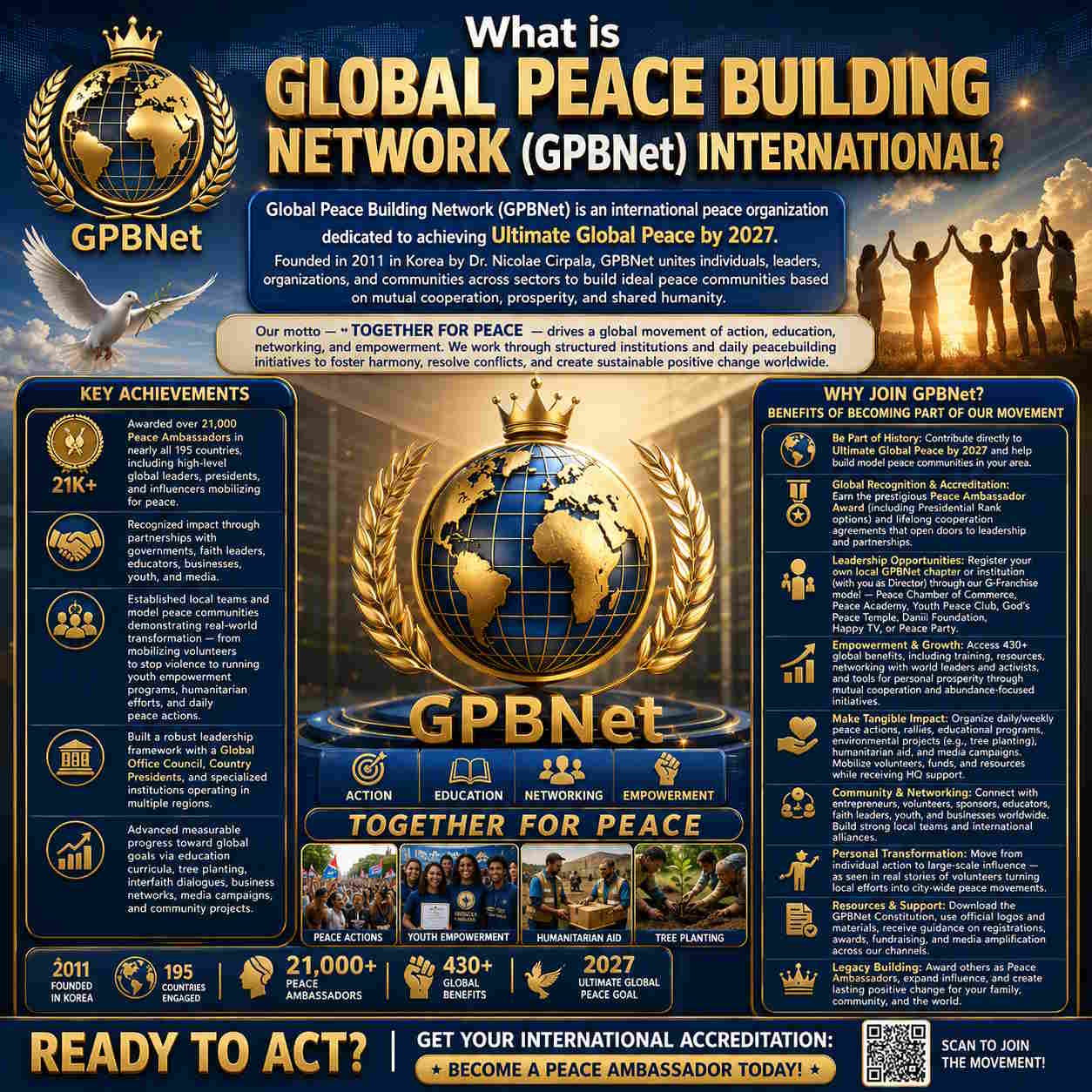
Global Peace Building Network (GPBNet) International is daily awarding global leaders to help them fulfill their life predestination while building a worldwide movement dedicated to achieving Ultimate Global Peace by 2027.

Founded in Korea in 2011 by Dr. Nicolae Cirpala, GPBNet brings together leaders, governments, organizations, communities, educators, businesses, faith leaders, youth and citizens under one simple motto:

TOGETHER FOR PEACE.

GPBNet says it has recognized more than 21,000 Peace Ambassadors across nearly 180–195 countries, including presidents, prime ministers, kings, ambassadors, religious leaders and other influential figures.

Its work goes beyond awarding: GPBNet building a  global network of peace actions, education, humanitarian initiatives, youth programs, environmental projects, interfaith dialogue, business cooperation, media campaigns and model peace communities.

🕊️ A PEACE RECOGNITION NETWORK OF EXTRAORDINARY SCALE

The Nobel Peace Prize is one of the world's most famous individual peace honors.

The United Nations has its own systems of recognition, appointments and international peace initiatives.

But GPBNet presents a different model:

A continuously expanding global network that recognizes peace ambassadors and connects them with practical, organized daily peacebuilding actions.

GPBNet's supplied records, its recognition network includes an extraordinary range of national leaders and international figures — from the UN Secretary-General and Pope to presidents, prime ministers, kings and other global leaders.

The objective is not simply to give an award.

The objective is to turn recognition into action — and action into Ultimate Global Peace This Year.

🌎 GLOBAL LEADERS RECOGNIZED IN THE GPBNet RECORD

⭐ International & Religious Leadership

  • António Guterres — Secretary-General of the United Nations
  • Pope Leo XIV — Pope
  • Patriarch Kirill (Cyril) — Patriarch of Moscow and All Rus', Primate of the Russian Orthodox Church
  • Ursula von der Leyen — President of the European Commission

🇨🇳 China

  • Xi Jinping — President of the People's Republic of China

🇷🇺 Russia

  • Vladimir Vladimirovich Putin — President of Russia

🇺🇸 United States

  • Donald Trump — President of the United States

🇫🇷 France

  • Emmanuel Macron — President of France

🇹🇷 Türkiye

  • Recep Tayyip Erdoğan — President of the Republic of Türkiye

🇸🇦 Saudi Arabia

  • Mohammed bin Salman — Prime Minister of Saudi Arabia

🇦🇪 United Arab Emirates

  • Mohamed bin Zayed Al Nahyan — President of the United Arab Emirates

🇲🇦 Morocco

  • Mohammed VI — King of Morocco

🇯🇵 Japan

  • Fumio Kishida — Prime Minister of Japan

🇰🇷 South Korea

  • Yoon Suk Yeol — President of the Republic of Korea
  • Lee Jae-myung — President of South Korea

🇰🇵 North Korea

  • Kim Jong Un — Leader of the Democratic People's Republic of Korea

🇮🇳 International Business & Technology

  • Elon Musk — Entrepreneur and technology leader
  •  presidents

🌍 Presidents, Prime Ministers & Heads of State

  • Salva Kiir Mayardit — President of South Sudan
  • Cyril Ramaphosa — President of South Africa
  • Alan Gagloev — President of South Ossetia
  • Sahle-Work Zewde — President of Ethiopia
  • Abiy Ahmed Ali — Prime Minister of Ethiopia
  • Isaias Afwerki — President of Eritrea
  • Teodoro Obiang Nguema Mbasogo — President of Equatorial Guinea
  • Daniel Noboa — President of Ecuador
  • Ranil Wickremesinghe — President of Sri Lanka
  • Ulf Kristersson — Prime Minister of Sweden
  • Viola Amherd — President of the Swiss Confederation
  • Gabriel Boric — President of Chile
  • Petr Pavel — President of the Czech Republic
  • Jakov Milatović — President of Montenegro
  • Mahamat Déby — President of Chad
  • Faustin-Archange Touadéra — President of the Central African Republic
  • Zoran Milanović — President of Croatia
  • Alexander Stubb — President of Finland
  • Bongbong Marcos — President of the Philippines
  • Luis Lacalle Pou — President of Uruguay
  • Shavkat Mirziyoyev — President of Uzbekistan
  • Yoweri Museveni — President of Uganda
  • Serdar Berdimuhamedow — President of Turkmenistan
  • Kais Saied — President of Tunisia
  • Samia Suluhu Hassan — President of Tanzania
  • Paetongtarn Shinawatra — Prime Minister of Thailand
  • Emomali Rahmon — President of Tajikistan
  • Julius Maada Bio — President of Sierra Leone
  • Osman Hussein — Prime Minister of Sudan
  • Hassan Sheikh Mohamud — President of Somalia
  • Nataša Pirc Musar — President of Slovenia
  • Peter Pellegrini — President of Slovakia
  • Bashar al-Assad — President of Syria
  • Lawrence Wong — Prime Minister of Singapore
  • Aleksandar Vučić — President of Serbia
  • Bassirou Diomaye Faye — President of Senegal
  • Gordana Siljanovska-Davkova — President of North Macedonia
  • Nayib Bukele — President of El Salvador
  • Klaus Iohannis — President of Romania
  • Paul Kagame — President of Rwanda
  • Marcelo Rebelo de Sousa — President of Portugal
  • Andrzej Duda — President of Poland
  • Dina Boluarte — President of Peru
  • Santiago Peña — President of Paraguay
  • José Raúl Mulino — President of Panama
  • Mahmoud Abbas — President of the State of Palestine
  • Asif Ali Zardari — President of Pakistan
  • Sultan Haitham bin Tarik — Head of State of Oman
  • Christopher Luxon — Prime Minister of New Zealand
  • Daniel Ortega — President of Nicaragua
  • Dick Schoof — Prime Minister of the Netherlands
  • Bola Ahmed Tinubu — President of Nigeria
  • Ram Chandra Poudel — President of Nepal
  • Nangolo Mbumba — President of Namibia
  • Min Aung Hlaing — President of Myanmar
  • Ukhnaagiin Khürelsükh — President of Mongolia
  • Maia Sandu — President of the Republic of Moldova
  • Filipe Nyusi — President of Mozambique
  • Andrés Manuel López Obrador — President of Mexico
  • Henri, Grand Duke of Luxembourg — Grand Duke of Luxembourg
  • Gitanas Nausėda — President of Lithuania
  • Abdul Hamid Dbeibeh — Prime Minister of Libya
  • Najib Mikati — Prime Minister of Lebanon
  • Edgars Rinkēvičs — President of Latvia
  • Thongloun Sisoulith — President of Laos
  • Mishal Al-Ahmad Al-Jaber Al-Sabah — Emir of Kuwait
  • Miguel Díaz-Canel — President of Cuba
  • Alassane Ouattara — President of Côte d'Ivoire
  • Rodrigo Chaves Robles — President of Costa Rica
  • Denis Sassou Nguesso — President of the Republic of the Congo
  • Félix Tshisekedi — President of the Democratic Republic of the Congo
  • Gustavo Petro — President of Colombia
  • Emmerson Dambudzo Mnangagwa — President of Zimbabwe
  • List is growing daily

✨ NOW IT'S YOUR TURN

You don't have to be a president to become a Peace Leader.

You can become part of the same international ecosystem.

🕊️ GET YOUR GPBNET INTERNATIONAL PEACE ACCREDITATION

GPBNet offers an international accreditation framework for:

Individuals • Organizations • Businesses • NGOs • Schools • Universities • Governmental bodies • Faith communities • Youth organizations • Media • Cultural organizations • Community leaders • Professional associations • International institutions

The accreditation is designed to turn a commitment to peace into organized, documented and measurable action.

Your pathway can include:

APPLY → GET REVIEWED → RECEIVE ACCREDITATION → TAKE ACTION → REPORT RESULTS → RENEW & ADVANCE

High-performing participants may progress toward further recognition and Peace Ambassador status.

👑 BUILD YOUR OWN LEGACY OF PEACE

Join a global network where you can:

🌍 Build your own local GPBNet chapter
🤝 Connect with international peacebuilders and leaders
🎓 Access peace, leadership and entrepreneurship education
🌱 Organize environmental and community projects
🕊️ Lead dialogue and intercultural cooperation
👥 Mobilize youth and volunteers
📺 Use media and cultural platforms for positive storytelling
💼 Develop responsible business and social-impact initiatives
🏆 Recognize additional Peace Ambassadors
📜 Build a documented international record of peace service

GPBNet's ecosystem includes the Peace Chamber of Commerce, Peace Academy, Youth Peace Club, God's Peace Temple, Daniil Foundation for Peace, and Happy TV / Peace Media.

🚨 DON'T JUST WATCH HISTORY — ENJOY MAKE IT

21,000+ Peace Ambassadors.
Nearly 180–195 countries.
Presidents. Prime Ministers. Kings. Religious leaders. Global influencers.

And the mission continues:

ULTIMATE GLOBAL PEACE.

If you believe peace should be more than a speech, a ceremony or a promise —

JOIN GPBNET.

🕊️ APPLY FOR YOUR INTERNATIONAL PEACE ACCREDITATION

Build credibility.
Organize action.
Measure impact.
Unite people.
Become an Architect of Peace.

GPBNet — TOGETHER FOR PEACE.

Donald Trump

Xi Jinping

Vladimir Putin

Elon Musk

South Korea President Lee Jae Myung

António Guterres


International Accreditation • Ultimate Global Peace This Year

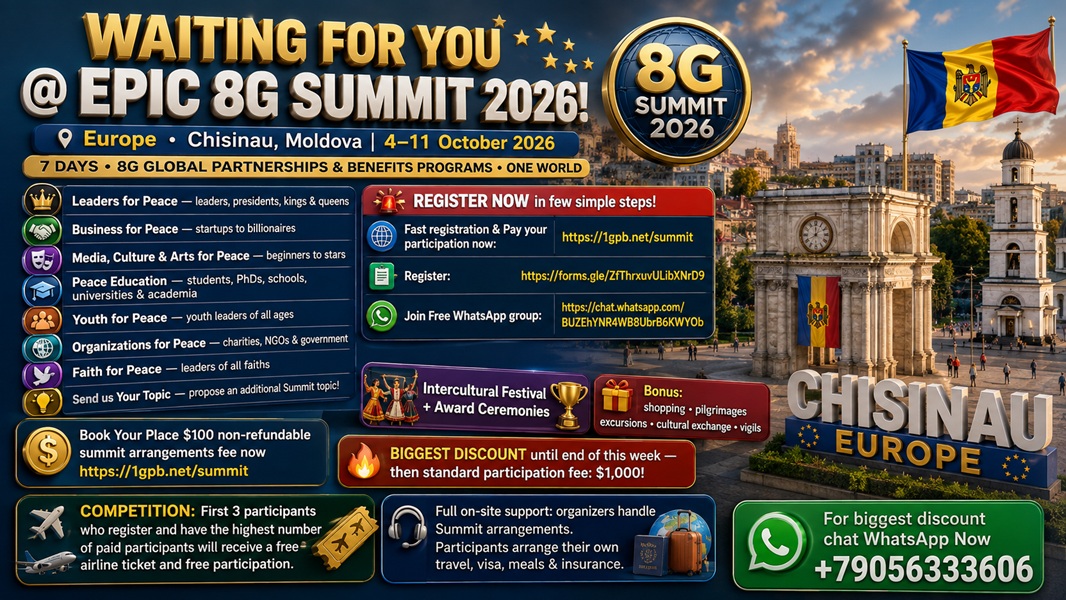
Register to 8G SUMMIT 2026! Europe • Chisinau, Moldova | 4–11 October 2026

WAITING FOR YOU @ EPIC 8G SUMMIT - EUROPE KICKSTARTS ULTIMATE GLOBAL PEACE 2026
Europe • Chisinau, Moldova | 4–11 October 2026

🚨 REGISTER NOW in few simple steps:

🌐 Fast registration & Pay your participation now:  


📝 Register: https://forms.gle/ZfThrxuvULibXNrD96G Summit

7 DAYS • 8G GLOBAL PARTNERSHIPS & BENEFITS ONE WORLD PROGRAMS:

👑 Leaders for Peace — leaders, presidents, kings & queens
💼 Business for Peace — from startups to billionaires
🎭 Media, Culture & Arts for Peace — from beginners to stars
🎓 Peace Education — from students, PhDs, schools, universities & academia
🧑‍🤝‍🧑 Youth for Peace — youth leaders of all ages
🌐 Organizations for Peace — charities, NGOs & government
🕊️ Faith for Peace — leaders of all faiths
💡 AI, NFT, GCoin For Peace - From developers to Business Executive & Owners

Send us Your Topic!

🎭 + Intercultural Festival + Award Ceremonies
🎁 Bonus: shopping • pilgrimages • excursions • cultural exchange • vigils

💰 Secure Your Seat Now $100 non-refundable summit arrangements mandatory fee  


(🔥 BIGGEST DISCOUNT until end of this week — then standard participation fee: $1,000!)

✈️ COMPETITION: First 3 participants who register and have the highest number of paid participants will receive a free airline ticket and free participation.

🤝 Full on-site support: organizers handle Summit arrangements.
✈️ Participants arrange their own travel, visa, meals & insurance. 

For all PARTNERSHIPS  Cooperation Proposals WhatsApp Now +79056333606

💬 Join Free WhatsApp group: https://chat.whatsapp.com/BUZEhYNR4WB8UbrB6KWYOb

🌎 Participants from EVERY country welcome:
Europe
Albania
Andorra
Austria
Belarus
Belgium
Bosnia and Herzegovina
Bulgaria
Czech Republic
Croatia
Cyprus
Denmark
Estonia
Finland
France
Georgia
Germany
Greece
Hungary
Ireland
Iceland
Italy
Latvia
Liechtenstein
Lithuania
Luxembourg
Malta
Monaco
Montenegro
Netherlands
North Macedonia
Norway
Poland
Portugal
Romania
Russia
San Marino
Serbia
Slovakia
Slovenia
Spain
Sweden
Switzerland
Turkey
Ukraine
United Kingdom
Vatican City
Americas & Caribbean
Antigua and Barbuda
Argentina
Bahamas
Barbados
Brazil
Canada
Chile
Colombia
Costa Rica
Dominica
Dominican Republic
Grenada
Guatemala
Honduras
Mexico
Nicaragua
Panama
Paraguay
Peru
Saint Kitts and Nevis
Saint Lucia
Saint Vincent and the Grenadines
El Salvador
Trinidad and Tobago
United States
Uruguay
Venezuela
Asia & Middle East
Armenia
Azerbaijan
Brunei
Israel
Japan
Kazakhstan
Kyrgyzstan
Malaysia
Singapore
South Korea
Tajikistan
Timor-Leste
United Arab Emirates
Uzbekistan
Oceania / Pacific
Australia
Kiribati
Marshall Islands
Micronesia
New Zealand
Palau
Samoa
Solomon Islands
Tonga
Tuvalu
Vanuatu
Africa
Mauritius
Seychelles
Also visa-free
Hong Kong SAR — passport holders
Macau SAR — passport holders
Qatar

Participants from all other countries who need visa to Moldova

are more then welcome to make visas by themselves Apply for  your E-Visa to Moldova https://www.evisa.gov.md/

and participate at the 8G Summit!

Exemption: If you hold a valid visa or residence permit issued by an EU/Schengen member state, the US, Canada, or the UK, you may enter Moldova without a separate Moldovan visa.


Business

Logistics

  • 1
  • 2
  • 3
  • 4

Articles - Latest

  • Shocking: How GPBNet stop Z Revolution in Africa and Globally in 2025 by Uniting Gen Z and Leaders
    Shocking: How GPBNet stop Z Revolution in Africa and Globally in 2025 by Uniting Gen Z and Leaders
    Blog 04.Sep
  • Breaking: How GPBNet stop Z Revolution in Africa and Globally in 2025 Changed Everything
    Breaking: How GPBNet stop Z Revolution in Africa and Globally in 2025 Changed Everything
    Blog 04.Sep
  • Donald Trump + Elon Musk + Vladimir Putin + Xi Jinping + Pope Leo XIV — WHO Was Awarded by GPBNet Till Now?
    Donald Trump + Elon Musk + Vladimir Putin + Xi Jinping + Pope Leo XIV — WHO Was Awarded by GPBNet Till Now?
    Blog 04.Sep
  • Register to 8G SUMMIT 2026! Europe • Chisinau, Moldova | 4–11 October 2026
    Register to 8G SUMMIT 2026! Europe • Chisinau, Moldova | 4–11 October 2026
    Blog 03.Sep
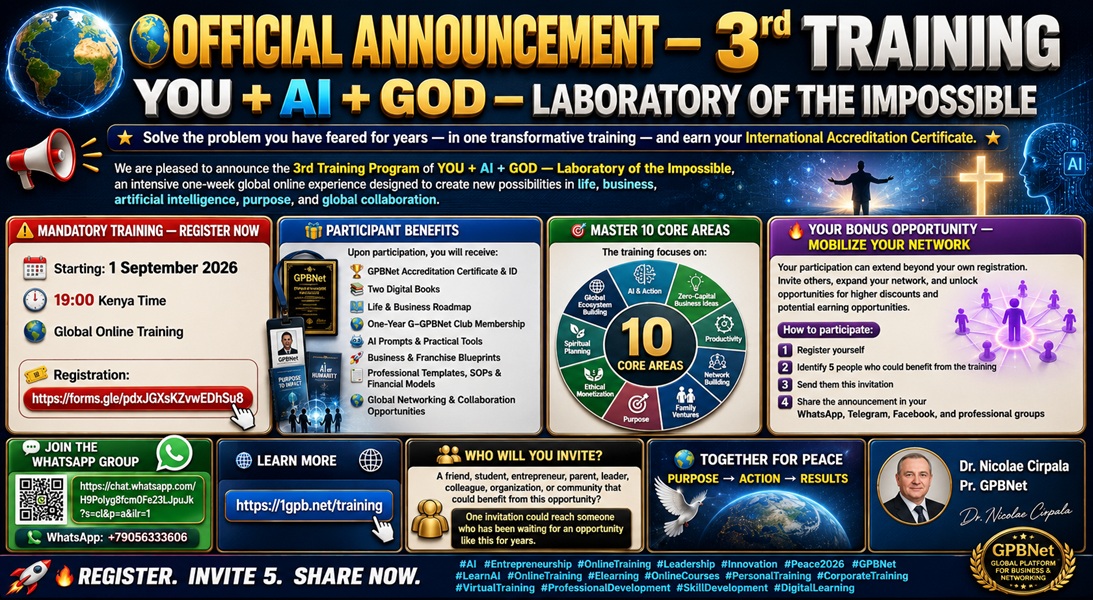
  •  Enjoy Register to 3rd G TRAINING🌍
    Enjoy Register to 3rd G TRAINING🌍
    Blog 30.Aug

POPULAR POSTS

  • What is Global Peace Building Network (GPBNet) International?
    What is Global Peace Building Network (GPBNet) International?
    30.Jan
  • Who are in GPBNet Team?
    Who are in GPBNet Team?
    30.Jan
  • Who is GPBNet Founder?
    Who is GPBNet Founder?
    30.Jan
  • How to help GPBNet?
    How to help GPBNet?
    30.Jan
  • Terms of Service
    Terms of Service
    20.Feb

Featured Posts

  •  Enjoy Register to 3rd G TRAINING🌍
    Enjoy Register to 3rd G TRAINING🌍
    Blog 30.Aug
  • Breaking: How GPBNet stop Z Revolution in Africa and Globally in 2025 Changed Everything
    Breaking: How GPBNet stop Z Revolution in Africa and Globally in 2025 Changed Everything
    Blog 04.Sep
  • COSMIC BOMBSHELL: Will Koreans Repeat the Israelites’ 2,000-Year Mistake on 31 August 2026?
    COSMIC BOMBSHELL: Will Koreans Repeat the Israelites’ 2,000-Year Mistake on 31 August 2026?
    Blog 30.Aug

Tags

  • Models
  • Beauty
  • Magazine
  • Fashion
  • Joomla
  • Tag 1

User

Show
  • Create an account
  • Forgot your username?
  • Forgot your password?

Support

  • Password Reset